Report: Path to 2024 — Did the 2024 election shift Americans’ attitudes about democracy?

In this final report for our Path to 2024 series, we examine how the election did or did not shift partisan attitudes. 

The build-up to the 2024 presidential election was marked by a significant sense of concern and dread. As election day came to pass, however, and Donald Trump assumed the title of president-elect, the most acute concerns around post-election instability did not materialize. 

Partisan Animosity
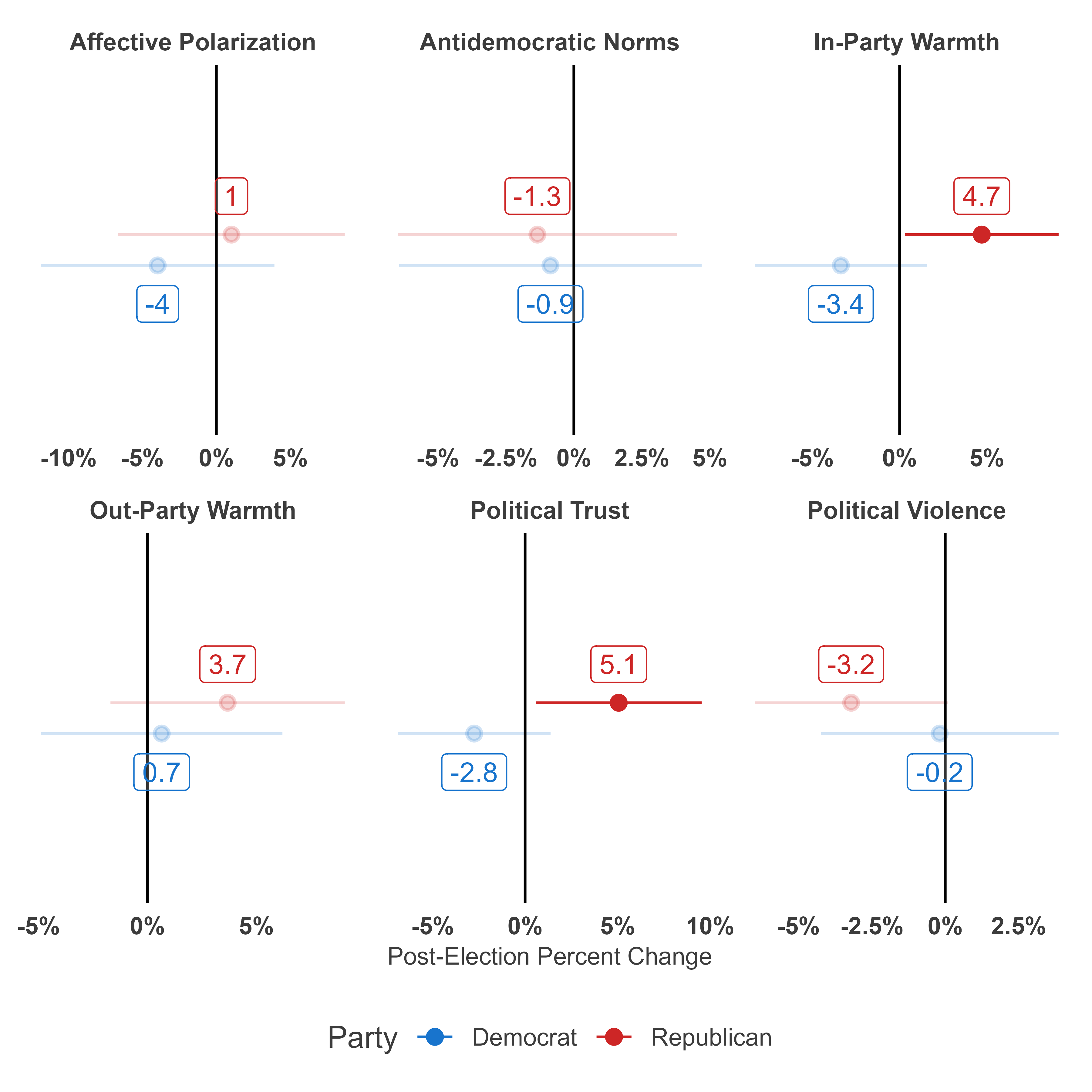
We find no difference in pre- and post-election levels of affective polarization. However, we do observe some difference in party-level differences. Democrats felt about 5% colder toward co-partisans after the election, whereas Republicans felt about 5% warmer toward out-partisans. 

Democratic Norms and Political Violence
We find no evidence of any movement in support for anti-democratic norms or political violence.

Accuracy, Trust, and Resignation
Democrats responded to the 2024 election with reduced perceptions of accuracy, while Republicans increased their feelings of accuracy by almost 50 percentage points. While a net increase in election confidence is certainly a desirable outcome, it potentially signals that democratic commitments are largely conditional on in-party success. Democrats became slightly more resigned to democratic backsliding than Republicans became less resigned.

Methods

Since September 2022 and through the November 2024 election, we have conducted weekly surveys of roughly 1,000 YouGov panel respondents (eligible for re-contact after 3 weeks), constituting a total sample of over 124,000 responses from 75,000 distinct respondents. In the days immediately before and after the election, we fielded responses to an expanded set of survey items related to perceived accuracy of the election and resignation around the possibility of democratic backsliding. This election-focused survey yielded 990 pre-election and 1,000 post-election responses. Our main analysis uses time-series cross-sectional data in an interrupted time series (ITS) design, regressing our outcomes of interest on a binary post-election indicator.

As a robustness check, we also we also conduct an analysis of 403 panel respondents who completed interviews both before and after the election. Only the positive change in trust from the prior set of results survives the panel robustness check, although the in-party warmth for Republicans now also becomes significant. Overall, this suggests the election had fairly minor, if any, effects on the broader set of attitudes non-specific to the 2024 election.

About the Path to 2024 Report Series

PRL’s Path to 2024 report series is a new monthly chronicle covering partisan attitudes of Americans in the lead-up to the November 2024 presidential election. Each month, we focus on a different salient issue affecting voters and analyze public attitudes from our weekly public opinion poll. We will take on topics ranging from attitudes toward policy issues, such as immigration, to the health of our democracy. Backed by hard data, we hope to inform and dispel myths about what everyday Americans really believe. The reports are produced and written in clear language by PRL political scientists.

Report: Path to 2024 — Election Expectations

What do Americans expect to happen in the 2024 election and its aftermath? This report examines who Americans expect will win the 2024 presidential election and if/when the losing candidate will/should concede. 

Most Americans perceive a tight race, but one where their party’s candidate will win

  • The median Democrat believes Harris has a 65% chance of winning and Trump a 46% chance. Republicans are slightly more confident in their own candidate, giving Trump a 70% chance and Harris 40%.
  • Confidence increases with affective polarization. Americans who dislike the opposing party/like their own party the most are about 20% more confident their party’s candidate will win the election than those with equal in- vs. out-party evaluations.

Partisans are split on their confidence in the candidates conceding the election.

  • Democrats are, on average, very confident that Harris will concede if she loses, but not confident at all that Trump will do the same.
  • Republicans have much more equal evaluations of each candidate: around 10-13% are either very confident either candidate will concede or have no confidence at all. 
  • Independents are in between Democrats and Republicans: they are more likely to believe Harris will concede than Trump, but not to the same extent that Democrats are.

Americans believe the losing candidate should concede, but don’t agree on when

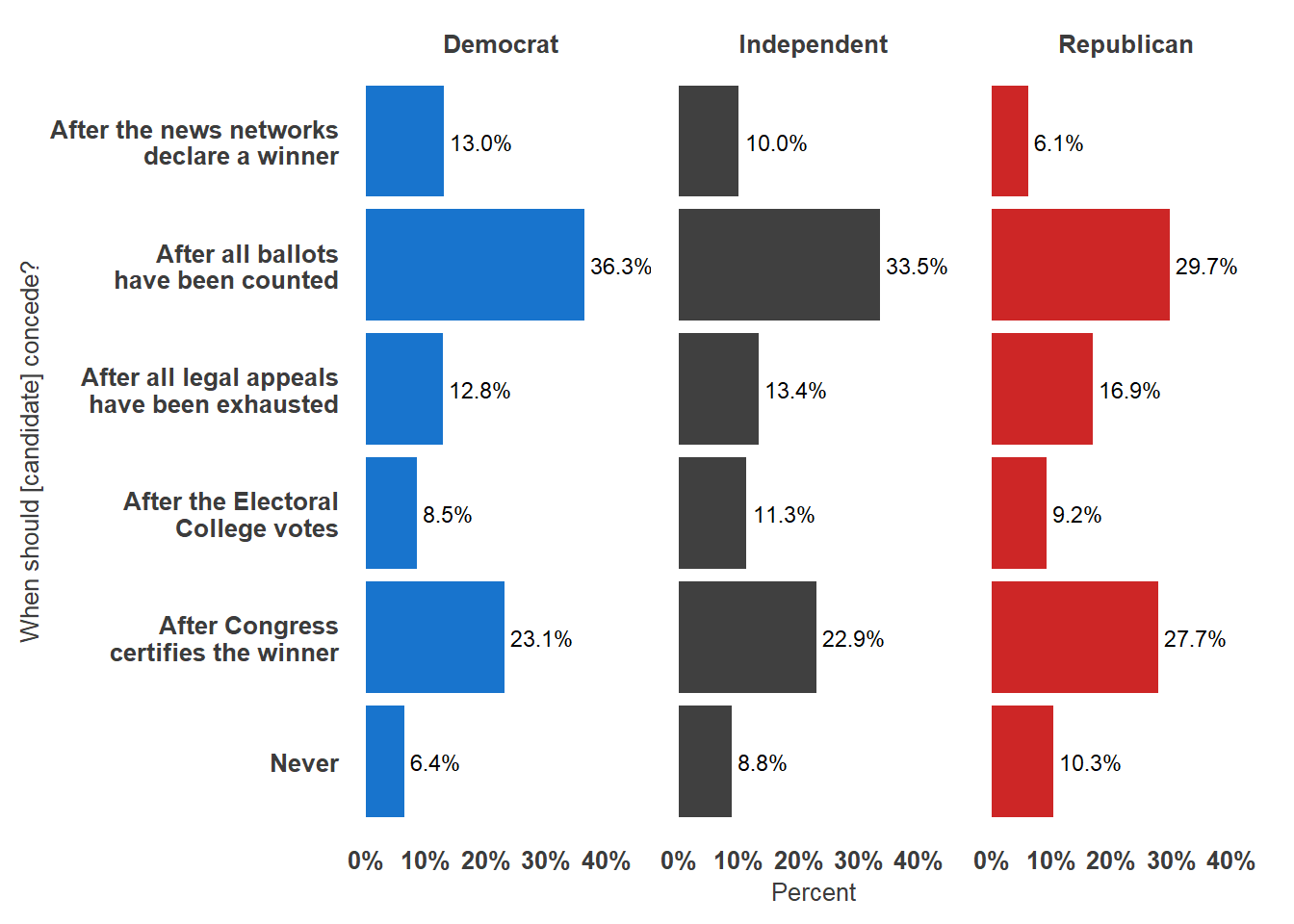
  • Only 6% of Democrats, 10% of Republicans, and 9% of Independents believe their candidate should never concede. 
  • A plurality of respondents believe concession should occur after all ballots have been counted, which can take several weeks.
  • The next largest group across all partisans believes concession should occur only after Congress certifies a winner, which occurs in January.

About the Path to 2024 Report Series

PRL’s Path to 2024 report series is a new monthly chronicle covering partisan attitudes of Americans in the lead-up to the November 2024 presidential election. Each month, we focus on a different salient issue affecting voters and analyze public attitudes from our weekly public opinion poll. We will take on topics ranging from attitudes toward policy issues, such as immigration, to the health of our democracy. Backed by hard data, we hope to inform and dispel myths about what everyday Americans really believe. The reports are produced and written in clear language by PRL political scientists.

Report: Path to 2024 – Perceptions of Political Scientists

How do Americans perceive political scientists? Many projects rely on political scientists as experts to comment on political events, evaluate candidates, and sometimes offer predictions on electoral outcomes. Our latest report examines how Americans view political scientists and their work. We find that Americans see political scientists as mostly Democratic, and have middling trust in their work. Americans are ambivalent on political scientists’ contributions to society.

Key findings include:

  • Americans see political scientists more politically diverse than they actually are. Democratic political scientists are seen as 9 percentage points more common than Republicans, although the actual gap may be greater than 50 percentage points.
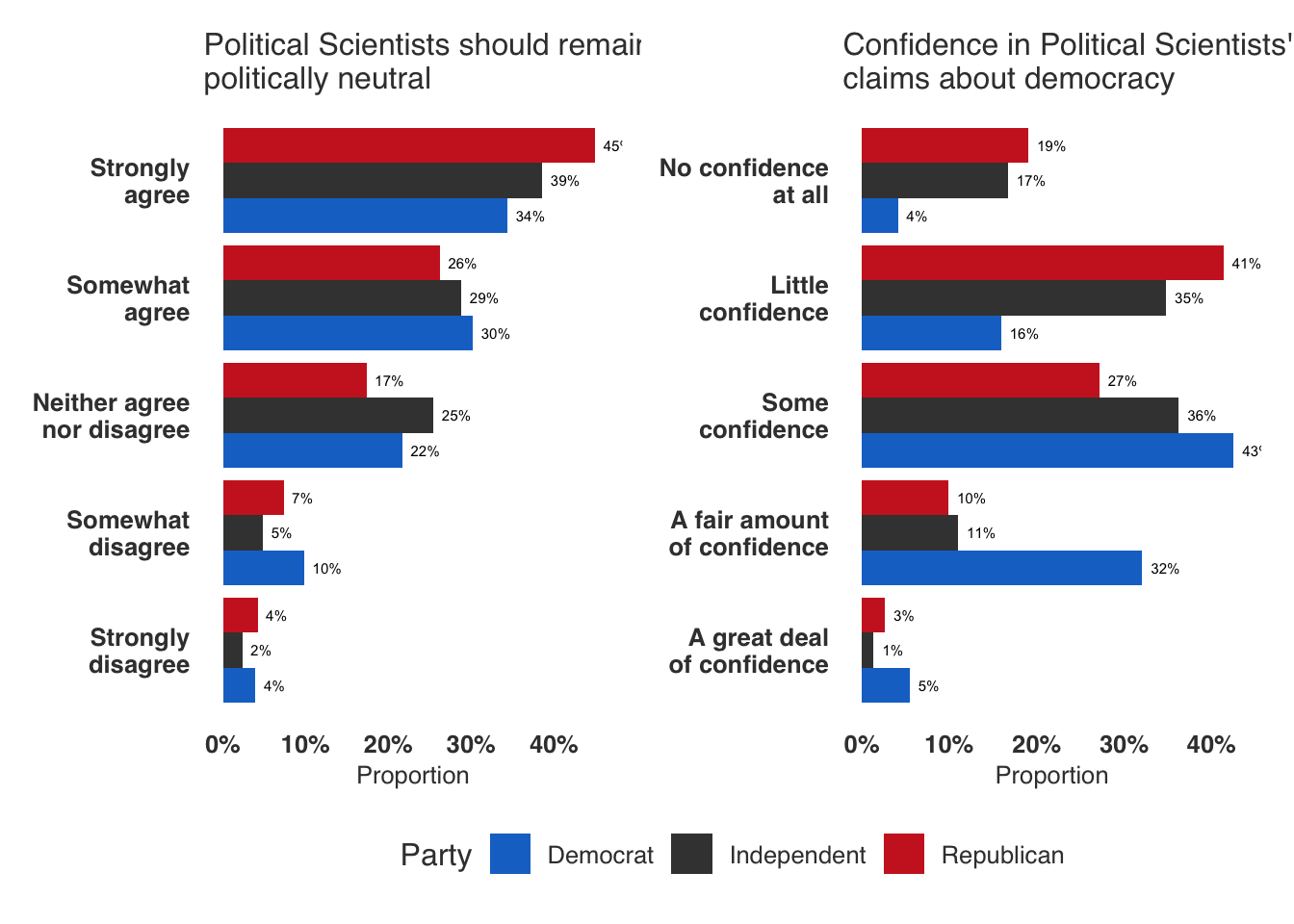
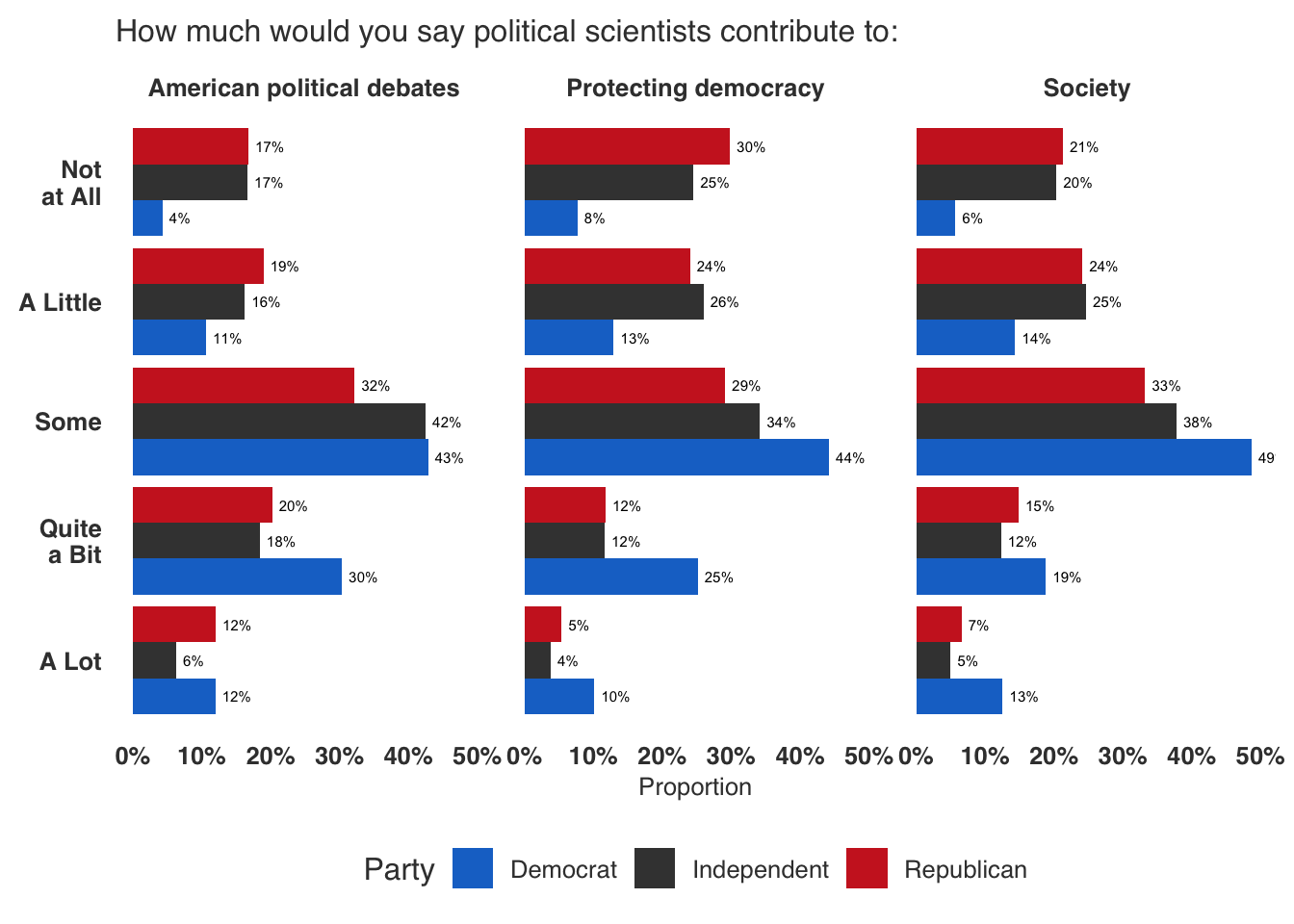
  • Democrats and Republicans are polarized on political scientists’ contributions. A majority of Republicans (60%) have little confidence in political scientists’ claims about democracy, compared to only 20% of Democrats. Similar gaps emerge in political scientists’ perceived contributions to society and American democracy.
This image has an empty alt attribute; its file name is contributions.png
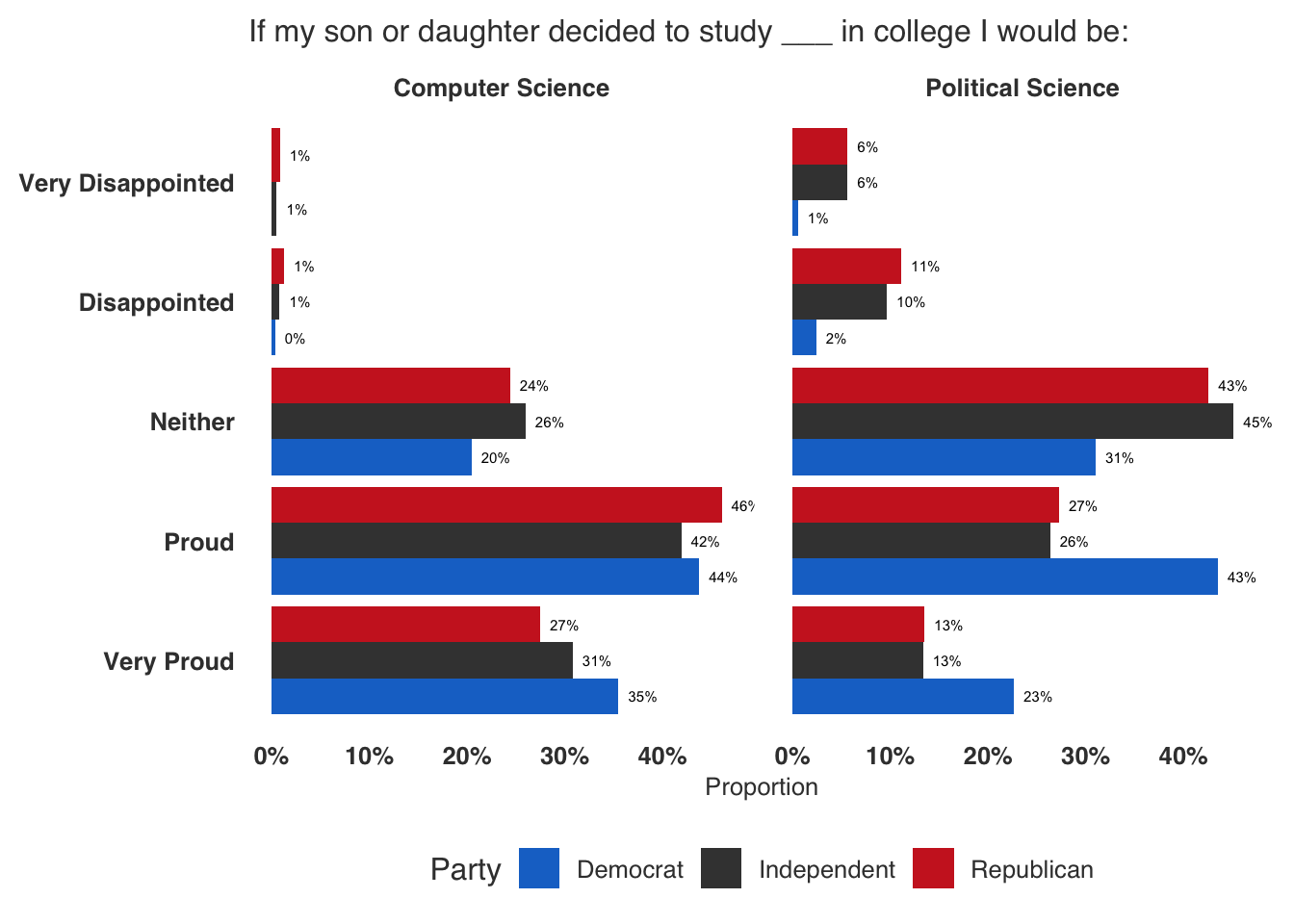
  • A majority of Americans would be indifferent to their child studying political science. 66% of Democrats say they would proud of their son or daughter studying political science, while 40% of Republicans would similarly be proud. Only 3% of Democrats and 17% would be disappointed in such an event.
  • Americans have a strong preference for neutrality. 71% of Republicans and 64% of Democrats agree political scientists should remain politically neutral.

About the Path to 2024 Report Series

PRL’s Path to 2024 report series is a new monthly chronicle covering partisan attitudes of Americans in the lead-up to the November 2024 presidential election. Each month, we focus on a different salient issue affecting voters and analyze public attitudes from our weekly public opinion poll. We will take on topics ranging from attitudes toward policy issues, such as immigration, to the health of our democracy. Backed by hard data, we hope to inform and dispel myths about what everyday Americans really believe. The reports are produced and written in clear language by PRL political scientists.
Report: The Path to 2024–Resignation to Democratic Backsliding

A majority of Americans are extremely concerned about but not resigned to the decline of democracy

Our latest report presents findings on democratic resignation–the idea that American democracy is deteriorating and very little can be done to stop it. We conducted two large surveys. The first in September 2022 (N=3516), a few months before the 2022 midterm elections, and the second (N=2000) in August 2024, a few months before the 2024 presidential election.

Large shares of Americans, in both 2022 and 2024, agreed with the statement that America is heading toward the end of democracy. However, the percentage of Americans who agreed with the statement substantially dropped between 2022 and 2024. When we first asked this question, 58 percent of Americans agreed with the statement, but by 2024, only 44 percent agreed.

While Americans are clearly worried, a majority disagree with the statement that “very little can be done to stop American democracy from ending in the next decade.” In 2022, 57 percent of Americans disagreed with the statement, and by 2024, 55 percent disagreed.

Partisan differences
In both 2022 and 2024, Republicans were substantially more concerned about the future of democracy than Democrats or Independents. In 2024, the gap between Democrats and Republicans substantially increased, with 55 percent of Republicans agreeing with the statement, while only 36 percent of Democrats. Democrats are increasingly optimistic. Feelings of resignation were not as polarized, although the gap grew in 2024.

Voting and resignation to democratic backsliding
When we look at the relationship between the importance of voting and the belief that America is heading toward the end of democracy, we see that the two are not necessarily related. In 2022, 60 percent of Americans who said voting was important also agreed that America was heading toward the end of democracy, while 56 percent of Americans who said voting was not important agreed with the statement.

In 2024, however, far fewer people who said voting was important agreed with the statement (45 percent), while the percentage of people who said voting was not important and agreed with the statement dropped only slightly (51 percent). It is the case that people who are resigned to the end of democracy are less likely to believe that voting is important. 


About the Path to 2024 Report Series

PRL’s Path to 2024 report series is a new monthly chronicle covering partisan attitudes of Americans in the lead-up to the November 2024 presidential election. Each month, we focus on a different salient issue affecting voters and analyze public attitudes from our weekly public opinion poll. We will take on topics ranging from attitudes toward policy issues, such as immigration, to the health of our democracy. Backed by hard data, we hope to inform and dispel myths about what everyday Americans really believe. The reports are produced and written in clear language by PRL political scientists.

Report: Path to 2024 — SCOTUS

Issue 6

Amid growing concerns about Supreme Court power and ethics, we conducted a survey to gauge American attitudes toward the Supreme Court. As our survey shows, while Americans are divided over whether the Court has too much power, they overwhelmingly agree that it should not have more. Additionally, a majority of Americans believe that at least one Supreme Court Justice should be investigated for ethical lapses. Democrats and Republicans are severely polarized on this issue, with Democrats expressing far more concern about Supreme Court power and ethics. We also explored gender gaps, given the Supreme Courts recent decisions on abortion, and find sizable gaps between men and women, particularly among political independents.


About the Path to 2024 Report Series

PRL’s Path to 2024 report series is a new monthly chronicle covering partisan attitudes of Americans in the lead-up to the November 2024 presidential election. Each month, we focus on a different salient issue affecting voters and analyze public attitudes from our weekly public opinion poll. We will take on topics ranging from attitudes toward policy issues, such as immigration, to the health of our democracy. Backed by hard data, we hope to inform and dispel myths about what everyday Americans really believe. The reports are produced and written in clear language by PRL political scientists.
Report: Path to 2024 — Culture Wars

Issue 5

Our fifth report in our Path to the 2024 Presidential Election series examines culture war issues. We asked 3000 Americans throughout the month of May about their attitudes toward issues such as teaching critical race theory, transgender athletes, firearms, book bans, and more. The public is divided along partisan lines on some but not all issues. We also explore how racial background and generational divides influence opinions on culture war issues.


About the Path to 2024 Report Series

PRL’s Path to 2024 report series is a new monthly chronicle covering partisan attitudes of Americans in the lead-up to the November 2024 presidential election. Each month, we focus on a different salient issue affecting voters and analyze public attitudes from our weekly public opinion poll. We will take on topics ranging from attitudes toward policy issues, such as immigration, to the health of our democracy. Backed by hard data, we hope to inform and dispel myths about what everyday Americans really believe. The reports are produced and written in clear language by PRL political scientists.
Report: Path to 2024 – Corporate Political Action

Issue 4

Our fourth report in our Path to the 2024 Presidential Election series examines attitudes toward Corporate Political Action.

Americans, our results show, do not want corporations to take positions on social issues, but there are differences along partisan lines:

  • Only 27.8% of respondents believe corporations should take stances on social issues.
  • Many more Americans believe corporations take stances on social issues as a marketing tactic (70.9%) rather than because of sincere beliefs (33.5%).
  • Democrats are more likely to agree that corporations should take stances on corporate issues (39%) than Republicans (23.3%), and partisans perceive themselves as closer in beliefs with different sets of companies.
  • Differences in support for corporate activism exist between racial and age groups, but less-so among gender and income groups.

About the Path to 2024 Report Series

PRL’s Path to 2024 report series is a new monthly chronicle covering partisan attitudes of Americans in the lead-up to the November 2024 presidential election. Each month, we focus on a different salient issue affecting voters and analyze public attitudes from our weekly public opinion poll. We will take on topics ranging from attitudes toward policy issues, such as immigration, to the health of our democracy. Backed by hard data, we hope to inform and dispel myths about what everyday Americans really believe. The reports are produced and written in clear language by PRL political scientists.